 Sales & CRM
  Recruiting & ATS
  Healthcare
 Financial
 Legal
Legal Real Estate
 Education
 Field Services
 Docs
Docs SDKs
SDKs Tutorials
 API status
 Changelog
 Support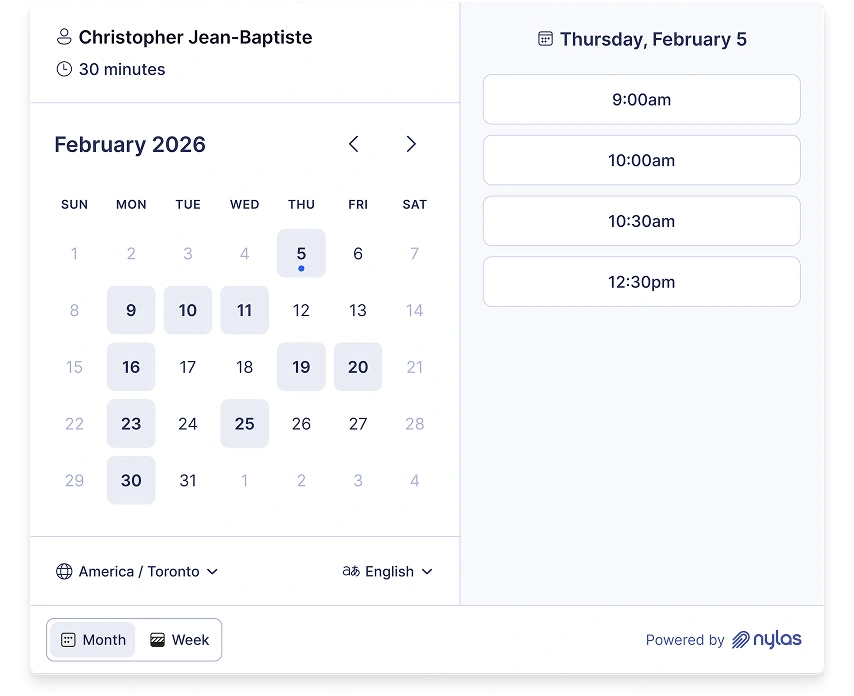
Interactive Booking Interface
A high-performance scheduling surface that handles timezone math and availability logic out of the box. Give your users a frictionless path from intent to confirmed event.
 Email and Contacts API
 Unified bi-directional sync and parsing for any provider.
 Calendar API & Scheduler
 Real-time availability and embeddable white-label booking.
 Notetaker API
 Capture, transcribe, and extract structured data from meetings.
 Agent Accounts
 Deploy, automate, and execute intelligent actions on your behalf.
A single abstracted layer for bi-directional sync across Google, Outlook, and Exchange. We manage the polling, state synchronization, and real-time webhook delivery so your database stays perfectly in sync with the source of truth.
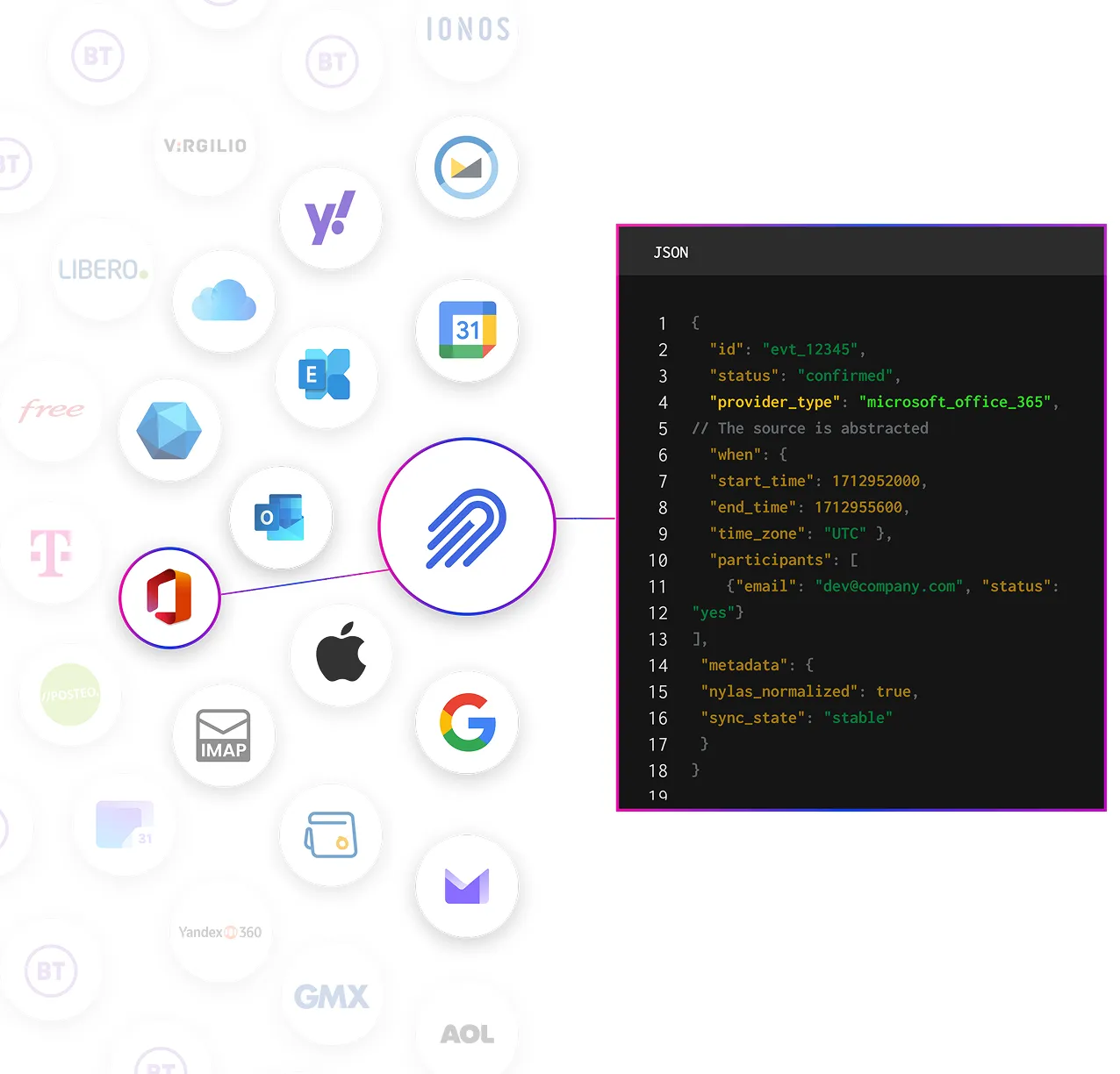
Native provider APIs are fragmented and inconsistent. Nylas abstracts the discrepancies into a high-performance infrastructure layer, giving you enterprise features out-of-the-box for every account.
| Technical Capability |
 Google
|
 Outlook
|
 Exchange
|
 iCloud
|

|
|---|---|---|---|---|---|
| Real-time Bi-directional Sync | |||||
| Universal Webhooks (Single Schema) | |||||
| Automated Rate-Limit Handling | |||||
| Virtual Calendars (Resource Booking) | |||||
| Unified Metadata Support | |||||
| Historical Data Ingestion |
calendar.updatedEvery calendar mutation across every connected provider triggers a structured webhook with full event context, participant status, and delta cursors for incremental sync. Webhook-first sync, with polling fallback for providers that don’t support push.
Delta sync cursors — only fetch what changed since your last checkpoint
Structured payloads with provider metadata, ical_uid, and recurrence context
Signature verification (HMAC-SHA256) on every delivery
Configurable event filters — subscribe to only the triggers you need.
// Header: X-Nylas-Signature: hmac_sha256=a3f8c2d1e9...
{
"specversion": "1.0",
"type": "event.created",
"source": "/nylas/calendar/events",
"id": "notif_9k3mZx8vL2",
"time": 1718304000,
"retry_config": {
"attempt": 1,
"max_retries": 3,
"backoff": "exponential"
},
"data": {
"object": "event",
"id": "evt_abc123def456",
"calendar_id": "cal_primary_9x2k",
"grant_id": "grant_8f2a4b6c",
"title": "Q3 Architecture Review",
"status": "confirmed",
"provider": "microsoft_office_365",
"when": {
"start_time": 1718304000,
"end_time": 1718307600,
"timezone": "America/New_York"
},
"participants": [
{ "email": "[email protected]", "status": "yes" },
{ "email": "[email protected]", "status": "maybe" }
],
"nylas_normalized": true
}
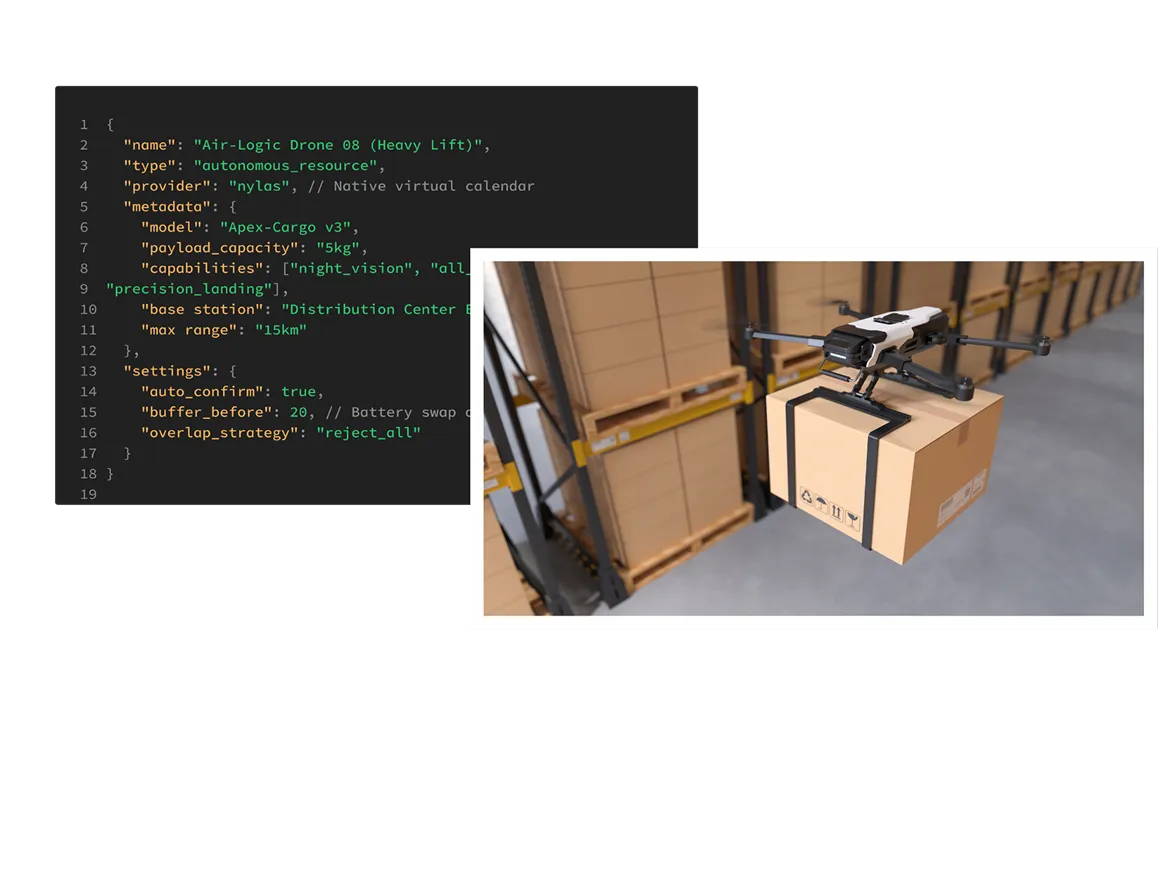
}Conference rooms, shared equipment, company vehicles, demo pods, anything you need to schedule but that doesn’t have a Google or Microsoft account. Virtual Calendars use the same API schema as provider calendars, so your existing integration code works without modification.
A UI layer that speaks your API’s language. Deploy pre-built components that natively understand your backend constraints, from availability windows to time-zone math, without writing a single line of sync logic.
Explore Scheduler
A high-performance scheduling surface that handles timezone math and availability logic out of the box. Give your users a frictionless path from intent to confirmed event.
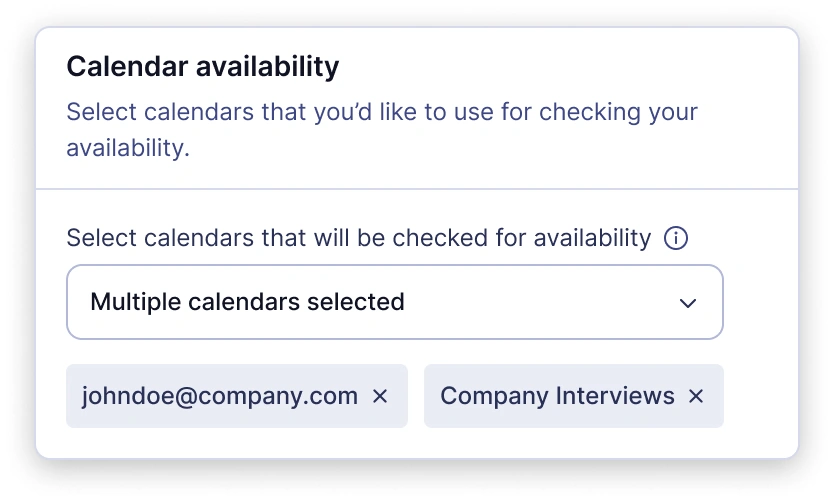
Empower users to aggregate multiple calendar sources. This component dynamically queries sub-calendars to ensure total accuracy across personal and professional schedules.
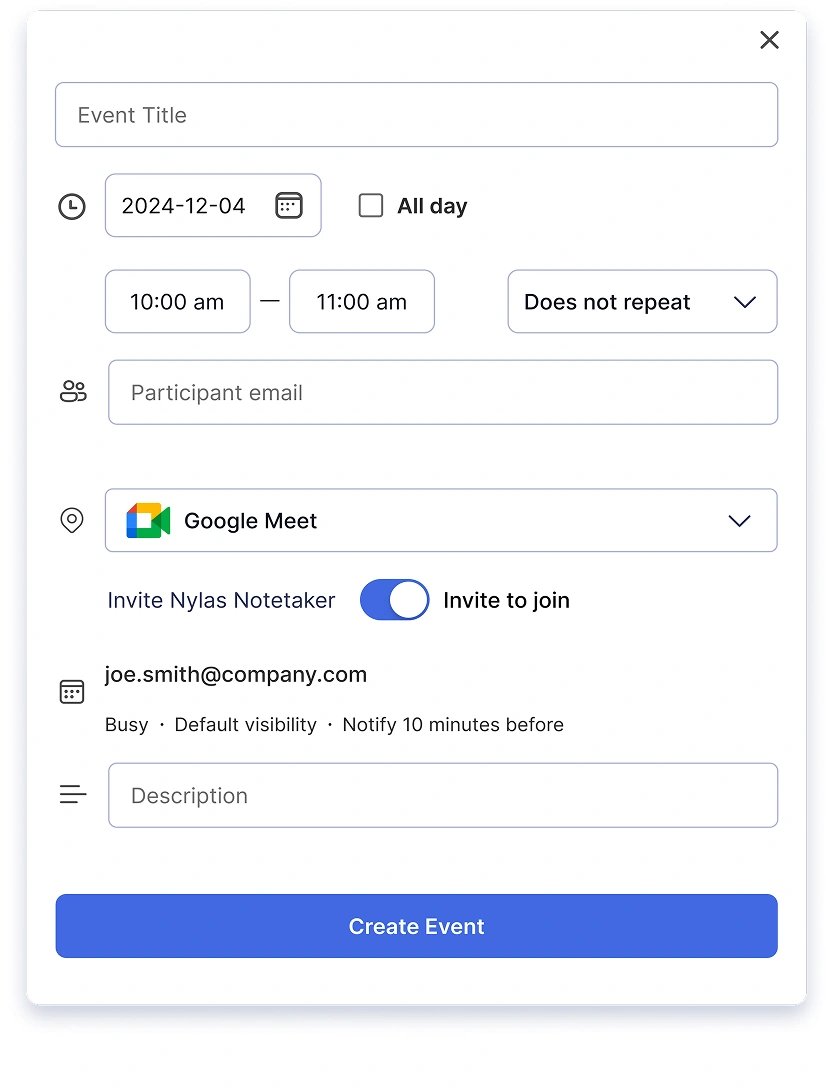
A full-stack modal for granular event control. Configure custom metadata, conferencing integrations, and participant routing without building complex form logic from scratch.
Google, Microsoft, Exchange, and iCloud each handle events differently. Nylas normalizes the differences into a single, predictable API surface, from sync to scheduling.

bi-directional sync across Google, Microsoft, Exchange, iCloud.
GET /v3/grants/{id}/events
event.created, event.updated, event.deleted triggers with customizable payload fields.

round-robin, open hours, buffer time, collective availability across up to 50 participants.
POST /v3/calendars/availability
resource booking without provider accounts, up to 10 per virtual account.
provider: 'virtual-calendar'
programmatic yes/no/maybe responses.

cross-provider free/busy lookups.
/calendars/free-busyCalendar data is sensitive. We treat it like healthcare data, encrypted at rest and in transit, audited continuously, and governed by strict data residency controls.


250,000+ developers trust Nylas to power calendar experiences their customers love.
“Bringing multiple channels into a single hub powered by Nylas has been a goldmine for user communication.”

“There’s no longer any disconnect with users copying and pasting information for scheduling or sending out manual emails. This has made a huge difference in response times.”

“Nylas can do the heavy lifting of integrating with proprietary APIs, allowing us to work with a simple, standardized API.”

“A unified calendaring experience is essential for lawyers to definitively know what event happened for what client at what time. They need to be organized and they often rely on shared calendars.”

The Nylas Calendar API lets you read, create, update, and manage calendar events across your users' existing calendars. Teams use it to build CRMs, scheduling workflows, internal tools, analytics dashboards, and AI-driven experiences — without managing provider-specific calendar integrations.
The Nylas Calendar API supports Google Calendar and Microsoft Outlook and Exchange, as well as other calendars available through compatible standard protocols.
Rather than building and maintaining two separate integrations — each with its own OAuth implementation, permission model, and API structure — you connect to Nylas once and access both providers through a unified API. Provider differences are abstracted at the Nylas layer.
Each provider has its own OAuth implementation, permission scope model, API structure, and deprecation cycle. Building directly means your team owns all of that complexity for every provider you support. The Nylas Calendar API handles provider differences through one integration, reducing the engineering surface area significantly.
Yes. You can create, update, cancel, and delete calendar events — including titles, descriptions, attendees, times, locations, and reminders. Changes sync directly to the user's connected calendar.
Yes. The Nylas Calendar API allows you to read past and upcoming events, subject to permissions granted by the user. This supports use cases like activity timelines, reporting, automation, and AI context building.
You can query availability and free/busy data to understand when users are available without exposing full event details. This is commonly used for scheduling logic, capacity planning, and workflow automation.
Yes. Changes made in your application or in the user's calendar provider are reflected in both directions, keeping your product and the user's calendar aligned in real time.
The API supports event creation, updates, and cancellations; recurring event structures; free/busy queries; multiple calendars per user account; conferencing link generation for Google Meet, Zoom, and Microsoft Teams; and two-way sync with supported providers.
The API supports event updates and cancellations, and provides webhook events to notify your application when calendar data changes — making it straightforward to keep systems in sync and respond to real-time updates.
The Calendar API is the data layer — it reads events, syncs calendars, and checks availability. The Scheduler is the booking layer — it surfaces availability to external users, handles booking logic, and creates confirmed meetings. Most scheduling products use both together.
Access is controlled through provider-specific permissions granted during user authentication. The Nylas Calendar API abstracts these differences while ensuring your application only accesses the calendar data users explicitly authorize.